

What is macro counting?
I get asked this ALL THE TIME so I wanted to put together a little resource to help you if you’re new to the concept of macro counting, which is also known as IIFYM or If It Fits Your Macros.
Macro counting is a nutrition strategy that you can use to meet your health and fitness goals. It’s flexible, sustainable and adaptable to your lifestyle. Best of all, there are no hard and fast rules like cutting out entire food groups, fasting for 12 hours, only drinking celery juice or not eating after 7pm. Amen, right?!
It may seem overwhelming at first, but it really just takes a little time and practice. Once you get into the swing of things, it becomes second nature. Seriously!
All food is made up of three main components or macronutrients. We shorten that long words to macros to say it more quickly. Those three macros are carbohydrates [carbs], fat and protein. Each food you eat and beverage you drink is made up of a combination of one, two or all three macros.
Now, each macro has a specific amount of calories associated with it. Carbs and protein have 4 calories per gram. Fat has 9 calories per gram. You don’t necessarily need to know that info to macro count because food labels and tracking apps do the math for you.
I do mention the calorie count because I often get asked the difference between counting calories and counting macros. If you’re not interested in the difference, skip over the next section — although you may learn some info that will blow your mind!
What’s the difference between counting calories and counting macros?
The short answer is that macros are much more precise.
If you’re consuming 1800 calories a day, it doesn’t mean that you’re eating enough protein to support your lean muscle, build muscle or replenish your muscles after a workout. It doesn’t mean that you’re eating enough carbs to supply your body with proper energy, fuel your brain or aid in digestion. It also doesn’t mean you’re eating enough healthy fat to reduce cravings between meals, reduce inflammation or balance your hormones. Or you could be eating too much, depending on your goals.
Calories are also rounded. You’ll never look at a food label and see that a serving has 177 calories. Any food under 50 calories is rounded to the nearest increment of 5. All foods over 50 calories are rounded to the nearest increment of 10. When we’re eating 15+ different foods in a day, all that rounding can skew our true caloric intake. Macros are never rounded and therefore, a more accurate representation of the food we eat.
As I mentioned before, macros have a specific calorie count attached to them. Carbs and protein have 4 calories per gram. Fat has 9 calories per gram. If you do the math on a nutrition label, it should add up to the total calories [rounded of course.] However, that isn’t always the case…
Take a look at the nutrition label below from a package of Mission Carb Balance Whole Wheat Tortillas. 30g carbs × 4 calories [120] + 6g fat × 9 [54] + 9g protein × 4 [36] = 210 total calories BUT the packaging lists 110 calories, so what’s the deal?
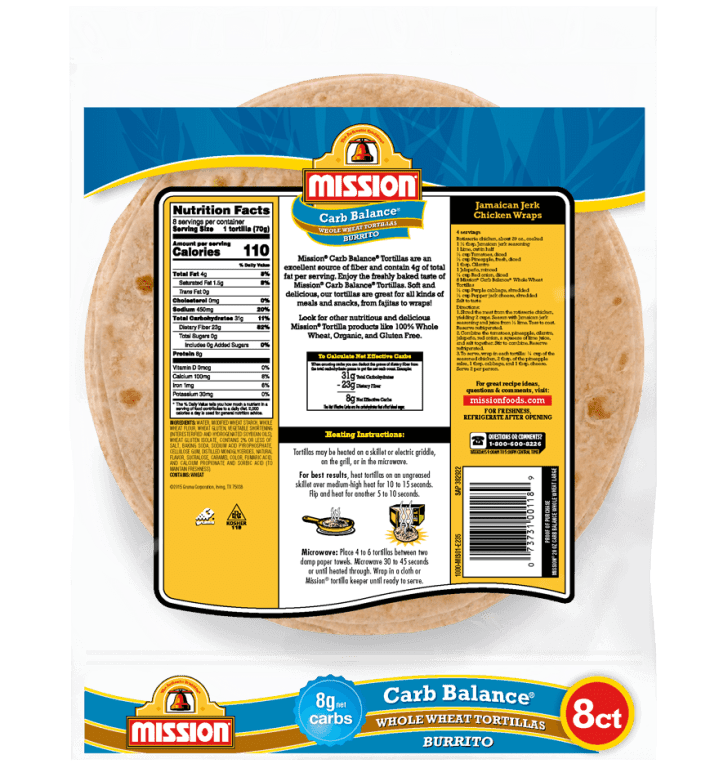
ANSWER — Nutrition labels are allowed to subtract the calories from fiber. These whole wheat wraps have 25g of fiber. Fiber is part of the carb count, which means it has 4 calories per gram. 25 × 4 = 100. The 210 actual calories – 100 fiber calories = 110 calories, which is what is listed on the label. Calorie counting would not take those 100 fiber calories into account, but macro counting does.
Now that you see the difference, let’s get into the good stuff!
How do I count macros?
This is the question on everyone’s mind!
First, you need to have your custom macros calculated, which will tell you how many grams of carbs, fat and protein you need to eat each day for your goals. Whether you’re looking to lose weight, lose body fat, gain muscle, build endurance or maintain your current body composition, counting macros can help!
There are free online calculators out there if you do a quick search on Google.
I also provide Custom Macro Breakdowns [more info here] based on an individual’s goals. Factors like pregnancy, breastfeeding, workout intensity/frequency, lack of workouts, health history, as well as gender, age, height, weight and activity level are all taken into account.
Next, you need an app to track your macros. There are many out there. My clients all use My Fitness Pal, which is my app of choice. [However, I would not use MFP’s macro breakdown. It’s often not accurate!] Other popular apps are Lose It, Carb Manager, My Macros+ and My Plate.
Once you download the app of your choice and set your macros to your custom numbers, you will log all of the food you eat and the beverages you drink.
I highly recommend you use a kitchen scale to weigh your food and beverages. It is a MUCH more accurate way to measure than eyeballing or using measuring spoons/cups. Portion sizes are often a major misconception. It can be very eye-opening to see what an actual serving looks like when you weigh it out. Any scale that measures in ounces and grams will work, but choosing one that has a flat surface and can weigh over 10lbs for larger recipes is helpful.
I’ve used several over the years, but this is my all-time favorite scale! I’ve been using it every day for the past 2+ years with no issues, plus it has a 5-year warranty if you need it!
Once you have your custom macro numbers, an app to log your nutritional intake and a scale to weigh your foods + beverages, you’re ready to go!
I have all my tools ready, but now what?
First, I find it helpful to log a few days of your normal eating behaviors to see what a typical day looks like for you. It can show you what macro[s] you tend to gravitate toward and where you may need to up your intake.
Once you have tracked a few days, you’ll be able to make some observations based on your choices. You can use that data moving forward to help you. For example, you see that the salad you always order from Wendy’s has almost an entire’s days worth of fat. You may want to refrain from that choice in the future or switch out the dressing for one with lower fat. Or you notice your go-to breakfast has very little protein and in order to hit your daily goal, you decide to sub your standard muffin for something that packs a stronger protein punch.
Your personality and lifestyle will likely affect the strategy you use to macro count.
Are you type A and a total planner? If so, you’ll probably want to pre-plan your entire day out the night before. Entering all of your food into the app in advance will leave no room for guessing whether or not you will hit your numbers at the end of the day.
If that sounds exhausting, you may be on the other end of the spectrum. I call these individuals the “fly by the seat of their pants” kind of trackers. You simply log as you go and adjust dinner and possibly a post-dinner snack to fit your numbers when you get there. The longer you count macros and the more you understand which macros are in the foods you’re eating, the easier this becomes.
If you think that sounds too risky, but you’re not ready to commit to logging tomorrow in its entirety, you may fall into one of the middle strategies.
Logging your main meals in advance will give you a good idea of what your day will look like and then you can fill in the rest of your macros with snacks that fit as you go.
Or you can simply log your dinner in advance and work backward by filling in breakfast, lunch and snacks with the macros that are left.
You may want to play around with different strategies and figure out which method works best for you. You do not have to commit to a single strategy. Different situations may require you to implement a switch of tactics for tracking.
Please give yourself a little time and a lot of grace as you implement this new strategy. If you’re not hitting your numbers after a few days, do not get frustrated. My rule of thumb is to stay within +/- 5g of your target macros, #butlife! Things will come up that prevent us from always being spot on. Simply do the best that you can.
What should I eat?
I get asked this a LOT and my answer is always, “Food you enjoy!” If you’re not eating foods that you like and enjoy, you’re not going to continue for any length of time. This goes for any nutritional strategy or “diet” that you follow. Macro counting gives you flexibility, which is key to long-term sustainability.
My rule of thumb is to follow an 80/20 approach. 80% of the time I’m eating fruits, veggies, lean protein, healthy fats and complex carbs. The other 20% of the time, I’m including what I like to call “fun foods and beverages.” It’s all about balance. You can enjoy a glass of wine or an ice cream cone with your kids while still making progress toward your goals.
How do I eat that much protein?
Many people struggle the most with hitting their protein. There are a lot of great whole food protein sources like chicken, lean turkey, lean ground beef, lean pork, tuna + other types of fish, shrimp, beans, Greek yogurt, cottage cheese, milk, cheese, eggs and nuts. You can always supplement with protein bars and protein powder if needed. I include both in my nutritional arsenal, although not every day.
Protein Bars:
- These are my all-time favorite protein bars. The macros and the ingredients are amazing! They’re vegan and the texture may throw you off because they are a bit dry, but they’re worth a try. Blueberry Cobbler is my tried and true flavor.
- This is my second favorite protein bar! The macros are great, but they’re higher in fat. Chocolate Chip Cookie Dough is my go-to flavor.
- If you’re a fan of sweeter protein bars, you’re going to love this brand! They taste like a candy bar and only have 1g of sugar. Almond Bliss is my flavor of choice.
Protein Shakes:
- First, if you are in need of a single-serve blender, I have been using mine for over 7 years and it’s still working without fail! I’ve carted this little guy to work, the gym and on vacation. I’ve blended toast to make breadcrumbs, salad dressing recipes and used it in place of a food processor. You can blend and go with the cup, which makes a protein shake a quick option. I always dread cleaning our big blender, but I can quickly rinse my single-serve blender or pop it in the dishwasher. All for under $20! Can you tell how much I love it?!
- I use a few powders, depending on the flavor I want, but 95% of the time I reach for this chocolate protein powder tub. I mix it with a banana, almond milk and ice. It’s delicious! I’ve been throwing in super greens for the past couple of months, too. I can’t taste them and they’re full of needed micronutrients.
- Another vegan protein powder that is stocked in my kitchen is this brand in vanilla when I’m looking to change things up. I love mixing vanilla with blueberries, oats, almond milk and ice for a blueberry muffin protein shake.
- I also like to keep unflavored pea protein powder on hand for baking. It’s tasteless and ups the protein in muffins, cookies, oatmeal, etc. I typically grab one from Trader Joe’s much like this brand. Check out their recipes. The protein peanut butter cups look amazing!
I hope this resource helps you with your macro counting journey! If you find you need more support, macro coaching may be a great fit for you. Group and Individual coaching can be very helpful to provide guidance, support and accountability as you work toward your goals.
Feel free to contact me with any questions!
Also, as an Amazon Associate, I earn from qualifying purchases.
 Chiseled by Chelsea
One thought on “MACRO COUNTING — The Basics”